

Premium Direct Indexing™
First Trust Premium Direct Indexing strategies are designed for investors looking for a personalized investment approach that seeks to maximize tax efficiency while using options to enhance income or hedge equity positions. The strategies may offer transparent, easy to follow, outcome-based investments for:
- circle Risk Management
- circle Income Potential
- circle Growth Potential
Potential Benefits of
Premium Direct Indexing™
- circle Tax-Advantaged Investing
- circle Flexible Funding of an Account With Cash, In-Kind, or Both
- circle Structured Outcome Investing
- circle Enhanced Returns
- circle Financial Planning Integration
Premium Direct Indexing™
The “premium” aspect of Premium Direct Indexing represents the integration of an option overlay strategy which adds an additional layer of sophistication. This combination of direct indexing and options capabilities allows for a high degree of customization, making it possible to engineer portfolios that target individual risk tolerance, time horizons, income enhancement and tax objectives. First Trust Premium Direct Indexing strategies are professionally managed by our experienced portfolio management team using a disciplined investment process that actively monitors each portfolio for tax-loss harvesting opportunities, risk management, and income potential. Leveraging advanced technology and deep industry expertise, we stay attuned to market trends while maintaining a long-term focus on tax-efficient investing. Working closely with financial professionals, we simplify the complexities of options and direct indexing, enabling seamless integration of these customized solutions into their practice.
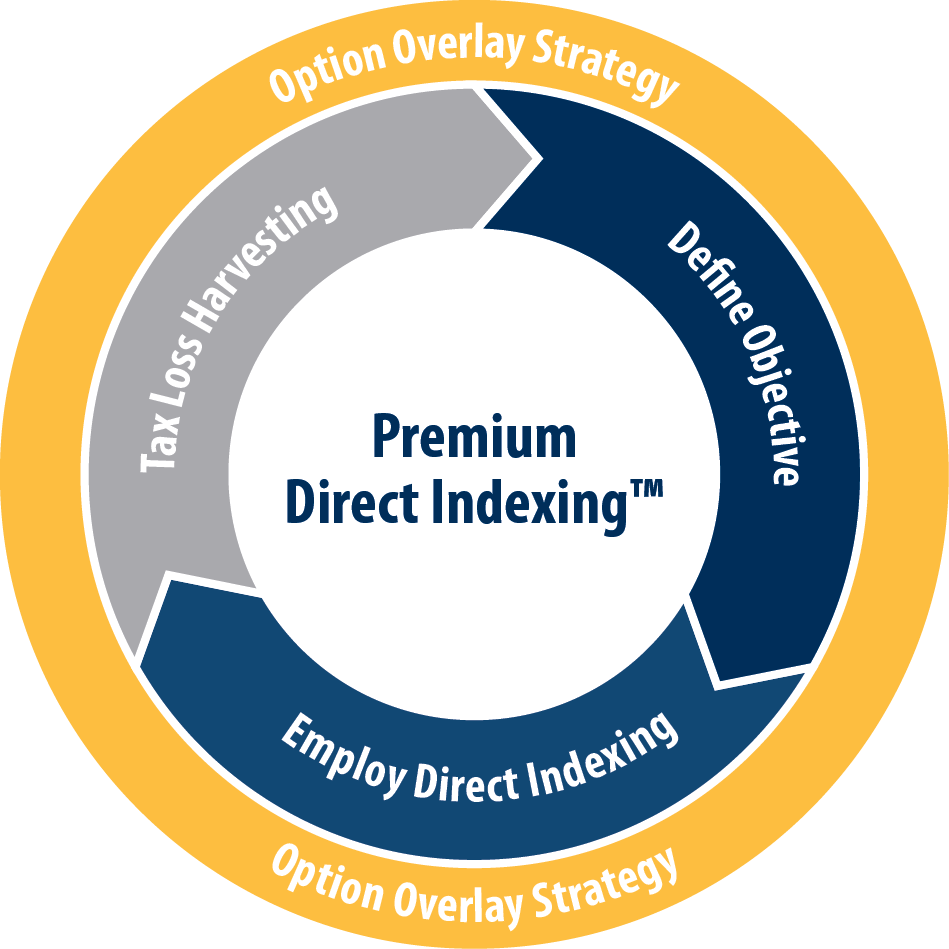
How it Works
Define Objective
Investors select a strategy, objective, and risk profile tailored to their investment needs.
Employ Direct Indexing
Portfolio holdings are optimized from a chosen benchmark to closely mimic its returns with minimal tracking error.
Tax Loss Harvesting
Our continual portfolio review with intra-day tax-loss harvesting seeks to maximize after-tax returns.
Option Overlay Strategy
Call options, put options, or a combination of the two are used to seek investment objectives such as enhancing income or hedging equity exposure.
Premium Direct Indexing™ Strategies
-
Enhanced Income
Enhanced Income strategies combine the potential benefits of direct indexing and options to seek to generate attractive levels of income that are generally higher than traditional equity or fixed income strategies.
-
Hedged Equity
Hedged Equity strategies combine the potential benefits of direct indexing and options to manage the downside risk or volatility of a portfolio over time.
IMPORTANT: THE INFORMATION CONTAINED HEREIN DOES NOT CONSTITUTE AN INVITATION, OFFER, SOLICITATION OR RECOMMENDATION TO ENGAGE IN ANY OPTIONS TRADING STRATEGY. An investment decision should not be made based solely on the information presented herein. There is no guarantee any options sold will not be exercised prior to the portfolio managers’ attempt to close out a short options position. This will cause an investor to sell shares of their existing stock position at the option strike price in the case of a call option, or purchase shares at the strike price in the case of a put option and will limit an investor’s ability to participate in potential gains or avoid losses beyond the strike price. This should not be construed as a representation that any portfolio will, or is likely to, achieve a specific level of profits, losses or tax savings. Results may vary over time. Accordingly, the information provided should not be considered indicative of the portfolio managers’ competence or skill.
Key Options Risks:
Options trading is not appropriate for all investors.
Writing and buying options are speculative activities and entail investment exposures that are greater than their cost would suggest, meaning that a small investment in an option could have a substantial impact on performance. The use of call and put options can lead to losses because of adverse movements in the price or value of the underlying stock, index, or other asset, which may be magnified by certain features of the options. These risks are heightened when options are used to enhance a client’s return or as a substitute for a position or security. When selling a call or put option, a client will receive a premium; however, this premium may not be enough to offset a loss incurred by the client if the price of the underlying asset is above or below, the strike price, respectively, by an amount equal to or greater than the premium. The value of an option may be adversely affected if the market for the option becomes less liquid or smaller and will be affected by changes in the value or yield of the option’s underlying asset, an increase in interest rates, a change in the actual or perceived volatility of the stock market or the underlying asset and the remaining time to expiration.
Writing a call or put option can lead to an assignment upon an exercise of a call or put option. In the case of a short call, an assignment can lead to a forced sale of the underlying security being held as collateral. Being short a put can lead to a forced purchase of the underlying security for which additional capital may have to be contributed by the account holder (i.e., “margin call”). Such involuntary sale and purchase transaction may occur at inopportune market times, which could result in losses to an account.
In the case of an option purchase (long call or long put), a client’s entire initial investment of premium can be lost. In the case of a covered option short sale (short call or short put), upside gains can be limited by the sale of a short call against an underlying stock position and a forced purchase of stock can occur in the case of a short cash covered put sale. In the case of a naked call or put sale (a call with no underlying stock position and a put with no cash to cover the possibility of a forced stock purchase) there is the risk of unlimited loss in the call position and substantial loss in the put position.
Options trading is not appropriate for all investors. There can be no assurance that a strategy will achieve its investment objectives.
Please refer to Characteristics and Risks of Standardized Options, also known as the options disclosure document (ODD), which discusses potential risks of options issued by the Options Clearing Corporation (OCC), which are typically listed on an exchange. Visit https://www.theocc.com/Company-Information/Documents-and-Archives/Options-Disclosure-Document.
The custom option strategies were previously managed by First Trust Investment Solutions (FTIS). Effective October 31, 2024, FTIS merged into First Trust Advisors L.P. (“FTA”). All business activities, including portfolio management and business records are now performed under FTA.
Kevin Erndl is the portfolio manager for the First Trust Advisors L.P. (“FTA”) custom options investment strategies which are offered in the form of a First Trust private fund (“Private Fund”) for which Mr. Erndl also sits on the Advisory Board and separately-managed accounts (“SMAs”). Mr. Erndl receives compensation from CWA Asset Management Group, LLC (“CWA”) for providing guidance and support to CWA clients who were previously clients of Mr. Erndl before he transitioned to FTA. He does not make any investment decisions on behalf of CWA clients and does not receive an advisory fee or other payment from his former CWA clients. If one of Mr. Erndl’s former CWA clients invests in the Private Fund or an SMA investing in a custom options strategy, those client assets are excluded from the FTA assets under management used to calculate Mr. Erndl’s compensation.